


.png)

What is SAGE? The case for a unified Search, Answer & Generative Engine optimization framework

Updated: Apr 17
SEO, AEO, and GEO are three distinct disciplines with one shared goal: making your content findable. It's time they had a common name — and a coherent strategy to match.
For the past two years, the content marketing industry has been quietly accumulating acronyms. First came AEO (Answer Engine Optimization) as Google's AI Overviews and voice assistants rewrote what "ranking" even means.
Then came GEO (Generative Engine Optimization) as LLMs like ChatGPT, Perplexity, and Claude became the first place millions of people go to ask a question.
We now have three distinct disciplines, three separate sets of tactics, and three different ways of measuring success — all supposedly aimed at the same thing: putting your brand in front of the right person at the right moment.
What's been missing is a name for all three working together — something that reflects how I actually think about content strategy now.
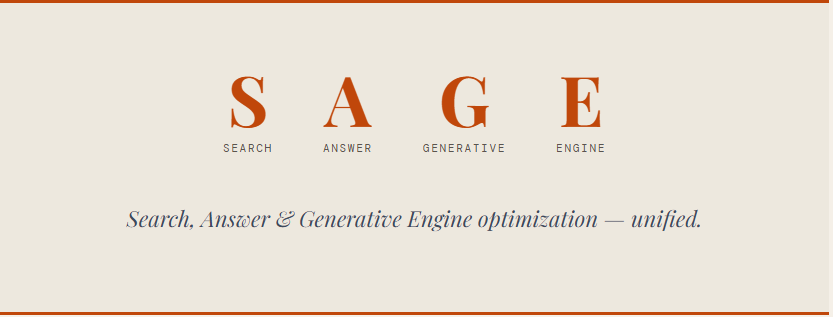
So the acronym I like to use is: SAGE.
Why the terminology problem matters
This isn't just semantic tidiness. The fragmented naming of SEO, AEO, and GEO reflects a fragmented way of thinking about content strategy — and that fragmentation has real consequences.
Teams are siloing their efforts. SEO specialists optimize for rankings. Content teams chase featured snippets.
Someone else worries about whether ChatGPT mentions the brand. These conversations happen in separate meetings, with separate tooling, measured against separate KPIs — despite the fact that the underlying content principles overlap almost entirely.
A recent EMARKETER analysis confirmed what many practitioners already suspected: no common taxonomy exists for the combined SEO, AEO, and GEO space. Agencies, publishers, and specialists have adopted multiple acronyms — GEO, AEO, GSO, LLMO, AIO — to describe overlapping tactics, with no consensus on what any of them mean in relation to the others.
The result is noise where there should be clarity.
Understanding the three layers
Before we can unify these disciplines, it helps to understand what each one actually does — and where they genuinely differ.

The differences are definitely real — but so is the shared DNA. All three reward the same fundamental qualities: authoritative sourcing, clear structure, genuine expertise, and content that directly addresses what a human is actually trying to learn or decide.
The tactics diverge at the edges. Schema markup matters more for AEO. Entity recognition and passage-level clarity matter more for GEO. Technical authority and backlink signals matter more for traditional SEO. But the content strategy layer — the question of what to write, for whom, with what evidence — is almost entirely shared.

How I think about the SAGE Stack
SAGE isn't a rebrand of SEO. It's a recognition that the search landscape now has multiple surfaces — traditional SERPs, AI answer boxes, and LLM conversation interfaces — and that a coherent content strategy needs to address all three simultaneously, from a single set of principles.
Think of it as a stack, not a checklist.
The foundation: search authority (SEO layer)
Traditional SEO remains the load-bearing wall of the entire structure. Generative engines don't operate in a vacuum — they draw on indexed, authoritative web content. A page that ranks well in Google is far more likely to be cited in an AI Overview or referenced by an LLM than a page that doesn't. You can't skip the foundation and expect the floors above it to hold.
Technical health: crawlability, page speed, Core Web Vitals
Topical authority through depth and internal linking
E-E-A-T signals: credentials, authorship, citations, freshness
Backlink profile and brand mentions across the web
The middle layer: answer-readiness (AEO layer)
AEO is fundamentally about structure. It's about formatting content so that AI systems can extract a clean, direct answer without needing to read the whole piece. This means question-based headings, concise paragraphs that stand alone, schema markup for FAQs and how-tos, and a disciplined commitment to answering the question before elaborating on it.
FAQ sections with complete, self-contained answers
FAQPage, HowTo, Article, and Organization schema
40–60 word "snippable" paragraphs under each key heading
Voice-compatible natural language phrasing
The surface layer: generative visibility (GEO layer)
GEO is where the newest rules are still being written — and where the signals are hardest to measure. LLMs cite sources based on a combination of authority, relevance, and what the training and retrieval systems have encountered most reliably. Original research, clear entity definitions, and consistent brand presence across high-authority platforms (including Reddit, LinkedIn, and Wikipedia) all increase the likelihood of citation.
Original data, research, or proprietary insights LLMs can attribute
Clear subject-predicate-object relationships for entity parsing
Passage-level optimization: each paragraph answerable as a unit
Brand presence on platforms LLMs draw from heavily
The SAGE insight: Content optimized well for any one of these layers almost always improves performance across the other two. The disciplines share a common root — authoritative, structured, human-first content. The SAGE framework just makes that connection explicit.
What SAGE changes in practice
Adopting SAGE as a working framework doesn't require a complete overhaul of your content process. It requires a shift in how you scope and brief content — from "optimize for keywords" to "optimize for all the surfaces where this query could be answered."
In practical terms, that means briefing content with three questions instead of one:
SEO: What search intent does this address, and does it have the authority to rank?
AEO: Can an AI system extract a clean answer from this without reading the full piece?
GEO: Is there something in this content — a stat, a definition, a perspective — that an LLM would want to cite?
When all three questions are answered in the brief, the content brief writes itself. When they're not asked at all, you get content that ranks adequately in 2023 and is invisible everywhere else.
Why "SAGE" specifically
Naming frameworks matters. A good acronym does two things: it makes the concept portable, and it carries meaning beyond its letters.
SAGE speaks to both. As a word, 'sage' means wisdom, experience, and considered judgement — qualities that describe both the content strategy itself (authoritative, structured, human-first) and the practitioner who implements it.
In a landscape drowning in reactive tactics and algorithm-chasing, "SAGE optimization" signals a fundamentally different orientation: one that builds for how people think, not just how crawlers rank.
The bottom line
The search landscape has expanded. Traditional SERPs, AI answer interfaces, and LLM-generated responses now all sit on the path between a question and the person asking it. Your content either shows up across all three — or it shows up inconsistently, expensively, and with diminishing returns as AI search adoption accelerates.
SEO, AEO, and GEO are not competitors. They are layers of the same discipline. A unified taxonomy and name allow us to build a coherent, future-ready content strategy around it.

Gia Pearson is a Content & SEO Strategist specializing in B2B tech, enterprise AI, and sustainability content. This article proposes SAGE as an original unified framework for Search, Answer & Generative Engine optimization.


Comments